


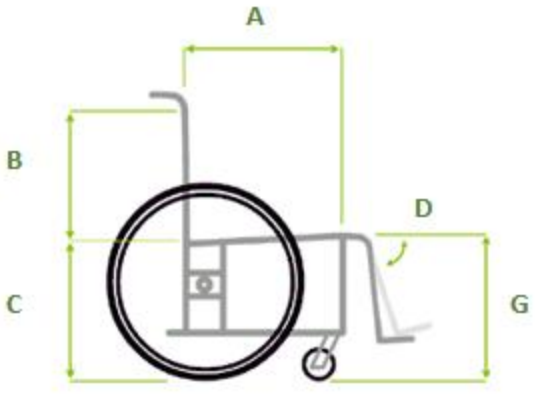
A-
Seat Depth
Measure from the most posterior point of the body to the inside of the knee, minus at least two inches.
Some prefer more leg overhang to make room for their hand when lifting their leg.
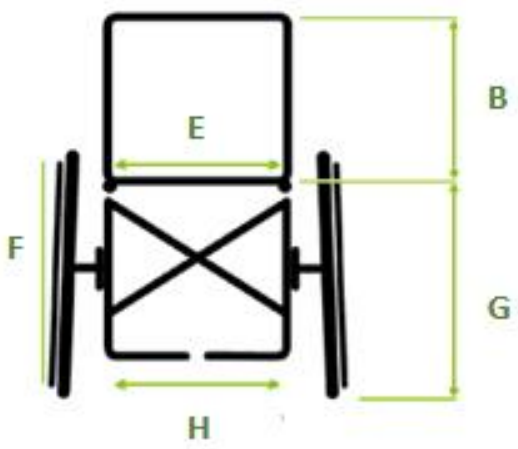
B-
Back Height
Measured from the seat base to the top of the wheelchair back. Depends on how much upper back
support is needed, and also affects freedom for the upper body to rotate.
c-
Rear Seat to Floor
Measurement from the ground to the rear seat edge. Relative to the front seat-to-floor dimension, this
determines the rearward slope ("dump" or "squeeze") of the wheelchair seat.
D-
Hanger Angle
Determines how far the toes extend away from the body, measured from the horizontal. A tighter angle
allows the wheelchair to turn around in less space. Depends in part on ability of the knee to bend
towards the perpendicular
E-
Seat Width
Determined by the widest point of the body from knee to hip, plus an inch to ensure room to move.
Consider bulk of clothing, particularly a heavy winter coat, if relevant.
F-
Wheel Camber
Angle of the wheel relative to the vertical. More camber improves stability and agility, but also limits
ability to pass through narrow spaces. A typical daily wheelchair uses three degrees of camber.
G-
Front Seat to Floor
Measure the leg from the back of the knee to the sole of the foot. Then subtract the thickness of the
cushion when it is compressed. Next, add a minimum of two inches for footrest clearance. Do not add
the footrest clearance if the wheelchair will be foot-propelled.
H-
Footrest Width
Measure from the inside of each leg rest tubing the distance or desired distance between leg rests.
H-
Footrest Width
Measure from the inside of each leg rest tubing the distance or desired distance between leg rests.
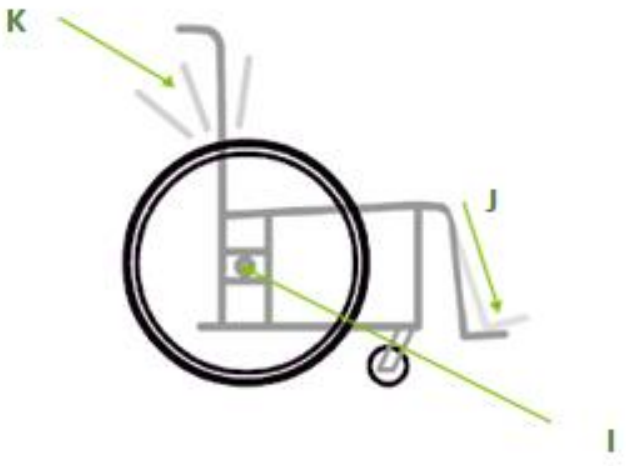
I-
Center of Gravity
Measure from the front of the seat back post to the center of the rear axle.
J-
Seat to Footrest Length
Measure from the edge of the seat upholstery to the top rear of the footrest.
K-
Backrest Angle
Measure the angle of the back post to the floor. Ninety degrees will be perpendicular to the floor, to
approximate the angle from the back post to the seat, subtract two degrees from measurement for every
.5" of dump