

-
Description

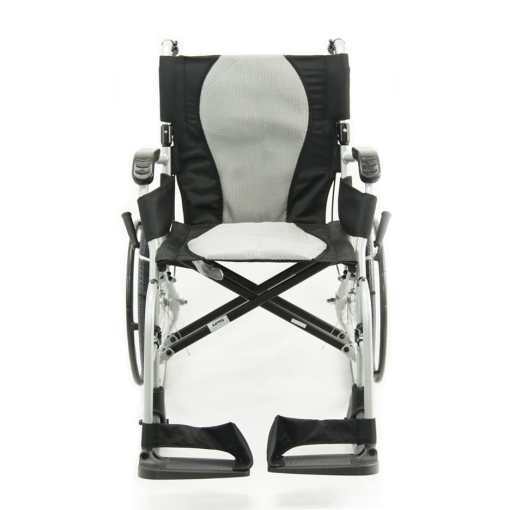
Ergo Flight
Ultra Lightweight Folding Wheelchair

Why Ergo Flight UltraLight Wheelchair?
Want to learn why the Ergo Flight ultralight wheelchair category wins as a leader in its category? In today’s market, people are tired of the heavy wheelchairs that were meant to promote mobility to disabled or mobility impaired individuals. Where mobility and ease of transportation were meant to be the primary importance of manufacturing a wheelchair, somehow manufactures got lost on what was most important to the people using the chairs.
Karman proudly announces the product that will redefine ultralight weight at the most competitive price. We did this by mixing a competitive metal (Aircraft Grade T6 Alu) with the most efficient geometry possible in designing a wheelchair.
What we get is a functional wheelchair that slashes price on any Titanium wheelchair driving economy directly to the homes of individuals that wish to have the ultimate mobility wheelchair possible. We also offer an Ergo Flight Transport version with 14″ rear wheels.
Ergo Flight UltraLight Wheelchair Features:
14.5 lb. Frame / 19.8 lb. (w/o footrest) for 16″ & 18″ Seat
24.2 lb. Frame (w/o footrest) for 20″ Seat
Revolutionizing and pushing T6 Grade Aluminum Geometry and Technology to its best to compete with Titanium saving YOU more than 71% in price!
Product Features - Weighs only 19.8 lbs (w/out footrest) – 14.5 lbs (w/out QR wheels & footrest) (16″&18″ seat); 20″ Seat Frame weighs 24.2 lbs (w/out footrest)
- Lightest T6 Alu Manual Propel Wheelchair on the market
- Globally Patented S-Style Ergonomic Seat Frame
- 6061 T-6 Aircraft-grade Aluminum
- Built in Aegis Anti-bacterial Padded Upholstery
- Fixed Armrest with Desk Length Ergonomic Padded Arm Pads
- Storage Pocket Behind Backrest
- Folding Backrest and Folding Seat
- Swing In/Away Removable footrest
- Companion Brakes Standard
- Polyurethane Front Casters: 6” x 1” (16″&18″ Seat) or 7” x 1” (20″ Seat)
- Rear Polyurethane, High Tread, Flat Free Wheels: 20” x 1 3/8” (16″&18″ Seat) or 22″ x 1/38″ (20″ Seat)
- 16” x 16” or 18” x 16” or 20″ x 17″ Seat Width
- Weight Capacity: 220 lbs (16″&18″ Seat); 250 lbs (20″ Seat)
- Frame Color: Pearl Silver
- WARRANTY
Product Measurements HCPCS Code K0004* Seat Width 16 inch., 18 inch., 20 inch Seat Depth 16 inch., 17 inch (for 20″ seat) Armrest Height 8 inch. Seat Height 19 inch., 20 Inch (for 20″ seat) Back Height 17 1/2 inch., 18 inch (for 20″ seat) Overall Height 36 inch., 37.5 Inch (for 20″ seat) Overall Open Width 22 3/4 inch., 24 3/4 inch., 26 3/4 inch Folded Width 13 inch. Overall Length 38 inch., 41 Inch (for 20″ seat) Weight Without Riggings 19 lbs., 24.2 lbs. (for 20″ seat) Weight Capacity 220 lbs. (16″&18″ seat), 250 lbs. (for 20″ Seat) Shipping Dimensions 31″ L x 33″ H x 13″ W -
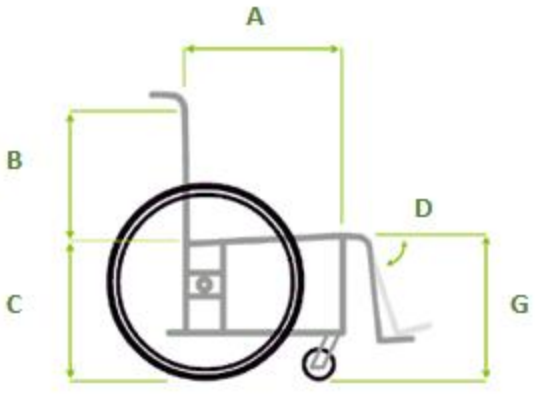
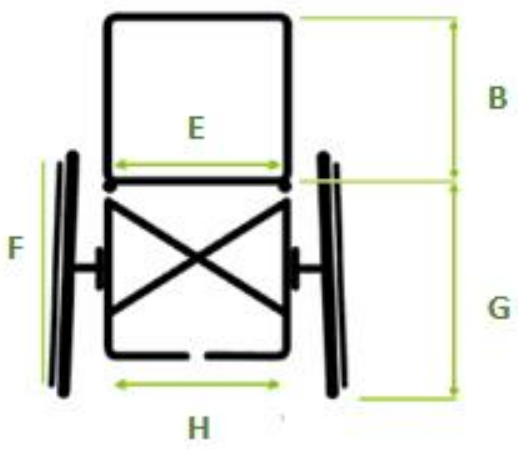
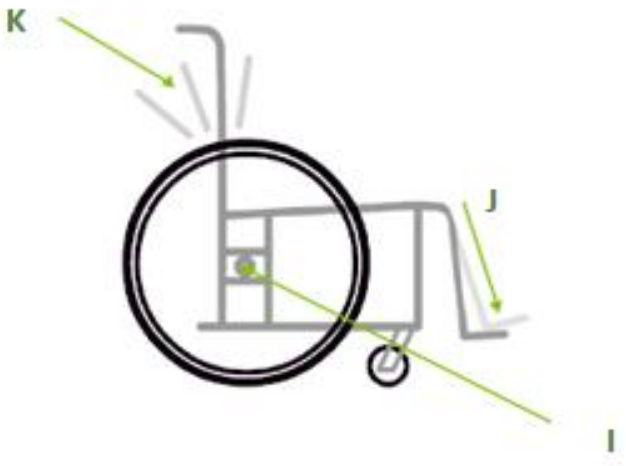
Size Chart / measuring guide
A-Seat DepthMeasure from the most posterior point of the body to the inside of the knee, minus at least two inches. Some prefer more leg overhang to make room for their hand when lifting their leg.B-Back HeightMeasured from the seat base to the top of the wheelchair back. Depends on how much upper back support is needed, and also affects freedom for the upper body to rotate.c-Rear Seat to FloorMeasurement from the ground to the rear seat edge. Relative to the front seat-to-floor dimension, this determines the rearward slope ("dump" or "squeeze") of the wheelchair seat.D-Hanger AngleDetermines how far the toes extend away from the body, measured from the horizontal. A tighter angle allows the wheelchair to turn around in less space. Depends in part on ability of the knee to bend towards the perpendicularE-Seat WidthDetermined by the widest point of the body from knee to hip, plus an inch to ensure room to move. Consider bulk of clothing, particularly a heavy winter coat, if relevant.F-Wheel CamberAngle of the wheel relative to the vertical. More camber improves stability and agility, but also limits ability to pass through narrow spaces. A typical daily wheelchair uses three degrees of camber.G-Front Seat to FloorMeasure the leg from the back of the knee to the sole of the foot. Then subtract the thickness of the cushion when it is compressed. Next, add a minimum of two inches for footrest clearance. Do not add the footrest clearance if the wheelchair will be foot-propelled.H-Footrest WidthMeasure from the inside of each leg rest tubing the distance or desired distance between leg rests.H-Footrest WidthMeasure from the inside of each leg rest tubing the distance or desired distance between leg rests.I-Center of GravityMeasure from the front of the seat back post to the center of the rear axle.J-Seat to Footrest LengthMeasure from the edge of the seat upholstery to the top rear of the footrest.K-Backrest AngleMeasure the angle of the back post to the floor. Ninety degrees will be perpendicular to the floor, to approximate the angle from the back post to the seat, subtract two degrees from measurement for every .5" of dump - Videos